Introducing a Series of Focused Briefs
Leading with Intent has long tracked trends in nonprofit board leadership. In 2023, we’ve taken a new approach to sharing those insights. Instead of a single, comprehensive report, the findings are presented as a series of focused briefs—each exploring a critical aspect of governance in greater depth.
These briefs draw on 2023 Leading with Intent data to examine how boards are structured, how they operate, and how governance practices shape organizational effectiveness. Each one connects data to real-world implications, offering a clearer view into how boards make decisions, whose perspectives are included, and how governance aligns with purpose.
Participant Profile Brief
This brief describes who is included in the 2023 Leading with Intent study—from organizational characteristics to board chair and chief executive demographics. These profiles set the context for the findings, shaping how we interpret board composition, leadership, and governance practices.
Methodology Brief
This brief explains how the 2023 Leading with Intent study was conducted, including how survey responses from chief executives and board chairs were collected and analyzed, and how external data from the IRS and Candid was used to strengthen the findings. It outlines who is included in the sample, how data was validated, and the key limitations to consider when interpreting results.
Nonprofit Leadership & Board Composition Brief
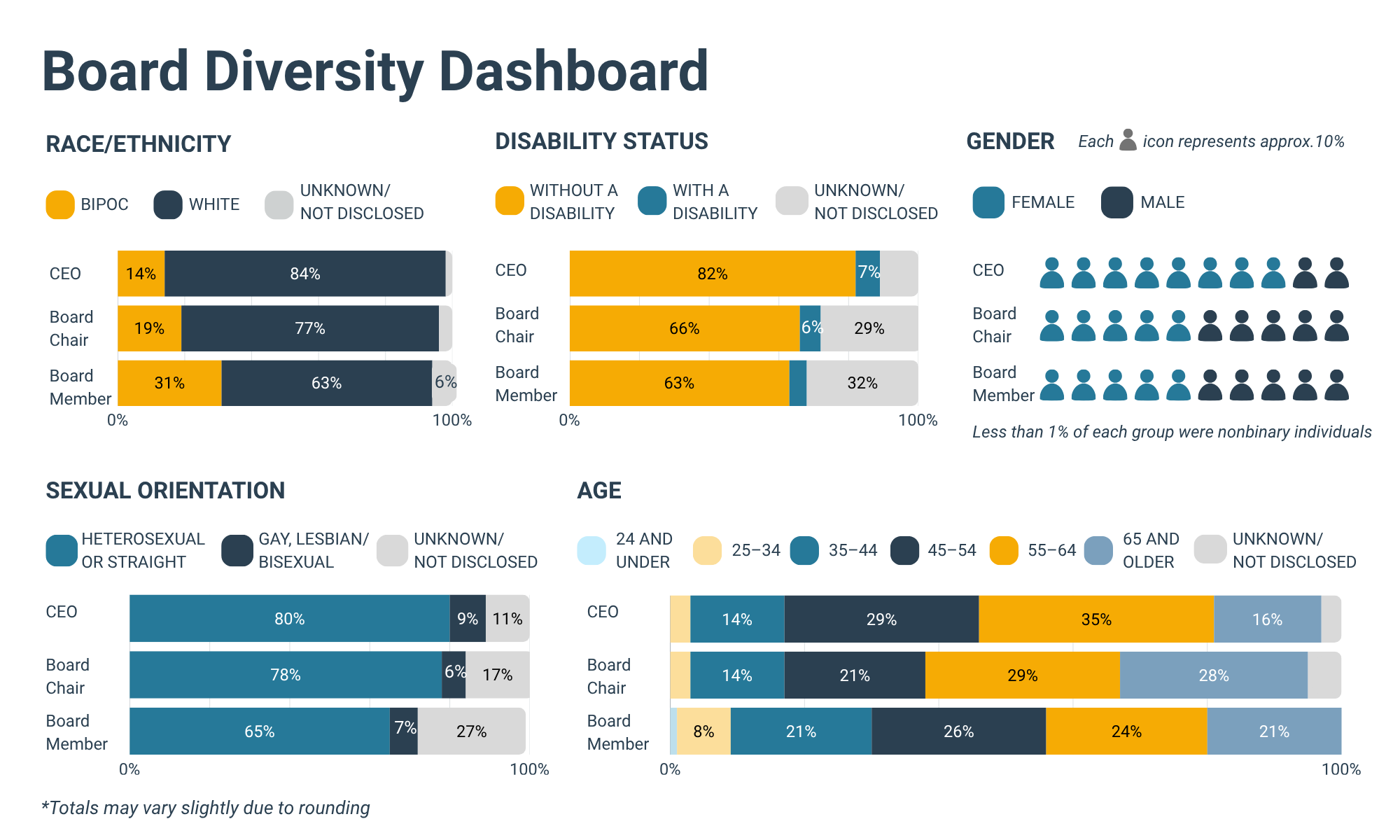
Who sits at the table shapes how boards lead. This brief examines the demographic makeup of nonprofit boards and chief executives—including race, gender, age, and disability—and where representation gaps persist across leadership roles. It highlights how composition influences whose perspectives are included in governance and who holds positions of influence.

Board Recruitment Brief
Recruitment decisions shape who holds power and whose perspectives influence governance. This brief examines how nonprofit boards identify and recruit new members, what qualifications they prioritize, and the barriers they face in recruitment. It explores the continued reliance on personal and professional networks, the role of lived experience and community membership in recruitment decisions, and how recruitment practices influence board composition, legitimacy, and governance capacity over time.
